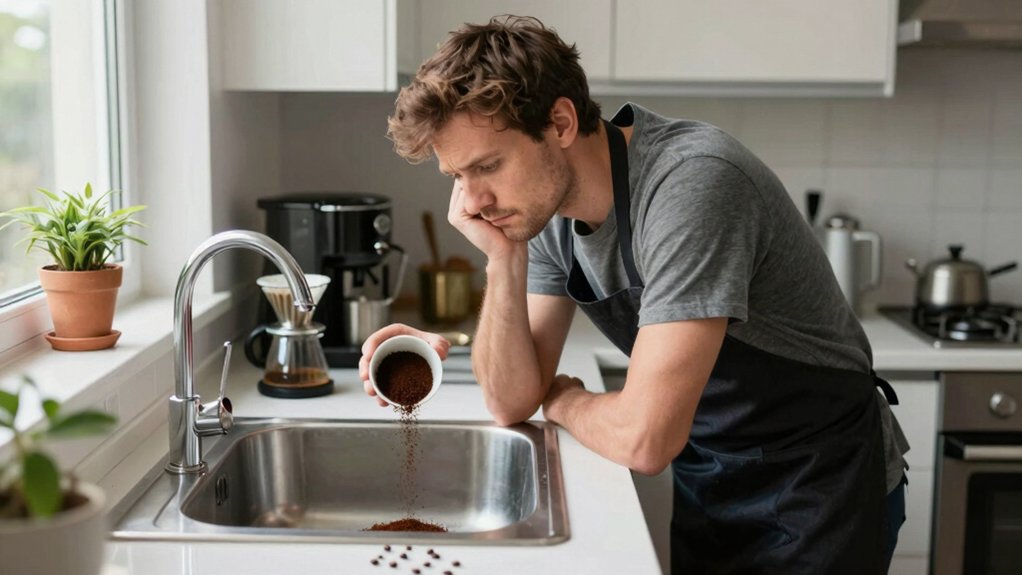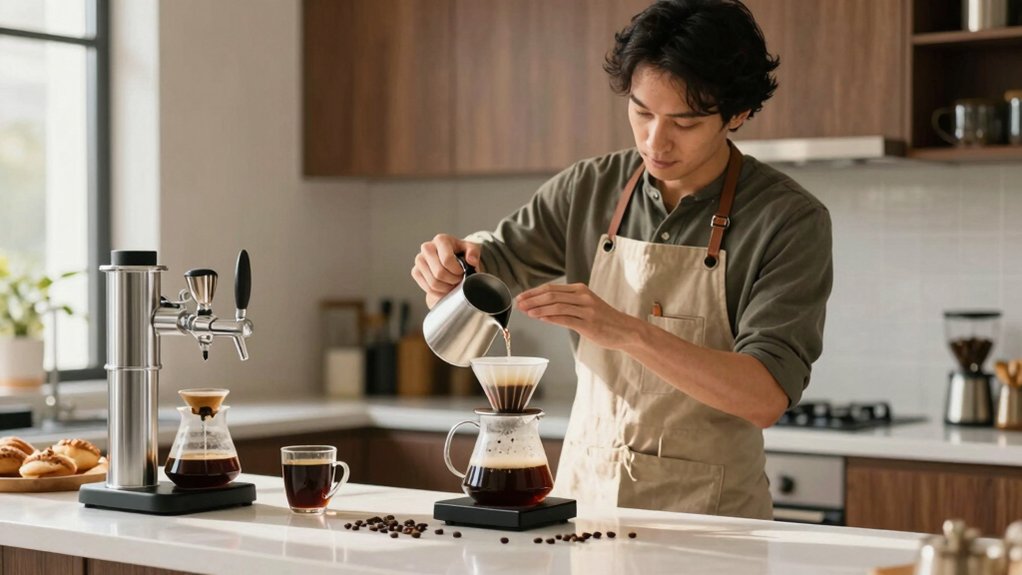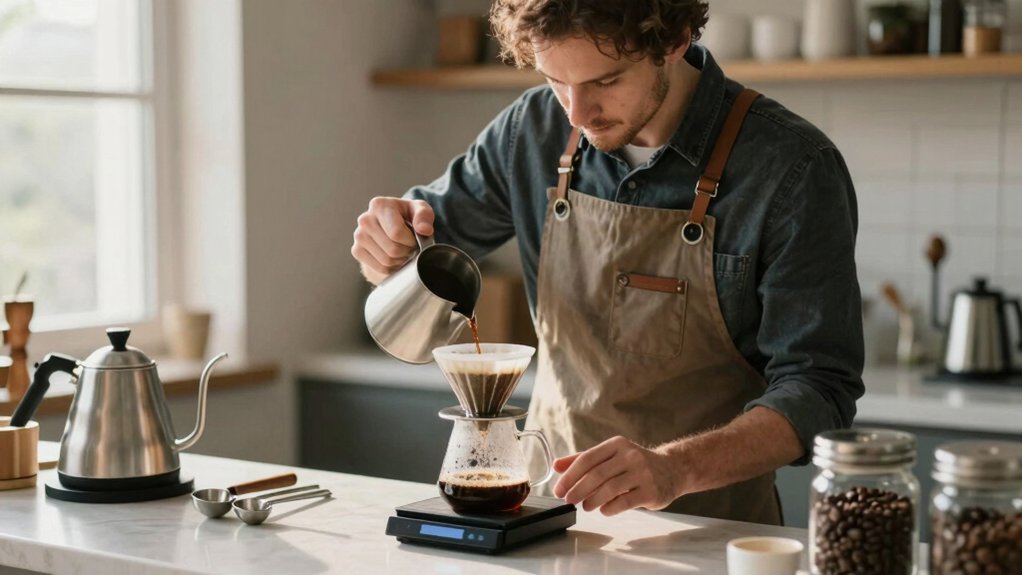
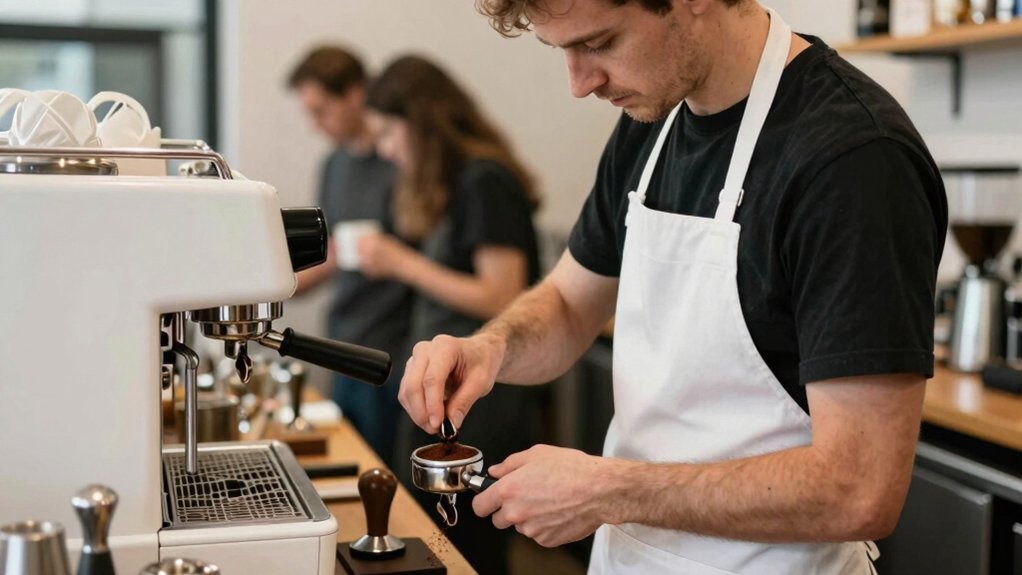

You might not realize that the ideal espresso grind isn’t just “fine,” but should specifically feel like granulated table salt between your fingers.
I find this texture creates the perfect resistance for a 25-30 second extraction, which studies from the Specialty Coffee Association confirm is key for balancing flavors. Getting this right is tricky, but my next tip on dialing in by taste will help you troubleshoot those sour or bitter shots.
Table of Contents
How fine should espresso coffee be ground
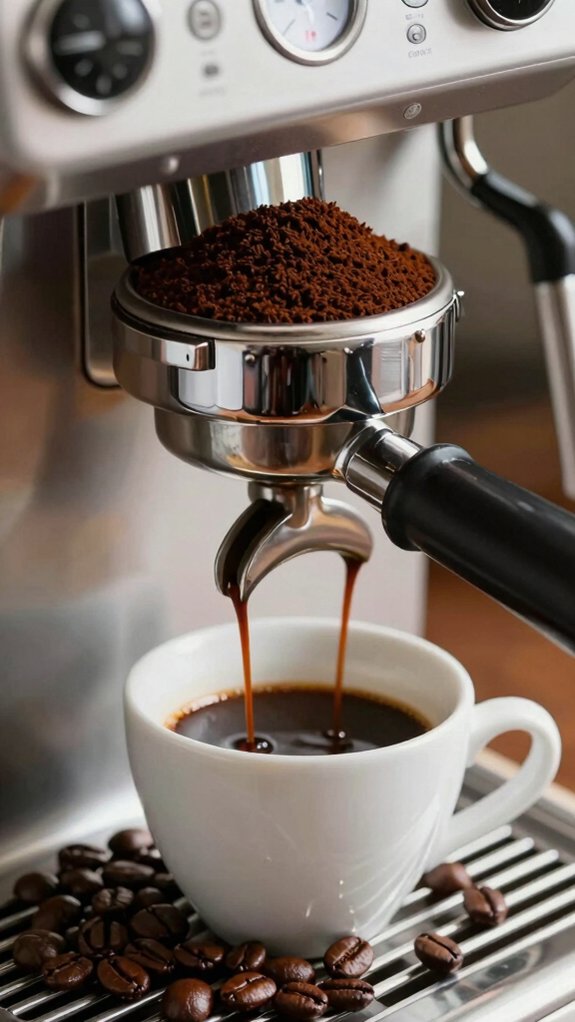
How fine should you grind coffee for espresso? You need a very fine grind, like table salt, to create the resistance needed for proper extraction at high pressure.
This perfect grind size is crucial because it directly controls your extraction time. A good rule of thumb is aiming for a shot that takes 25-30 seconds. If it’s too fast, make adjustments to your grind finer; if it’s too slow, go a bit coarser.
For the best consistency, I always recommend using quality burr grinders. They create uniform particles, which is the real secret to unlocking a balanced, flavorful espresso shot and avoiding bitterness.
Your coffee will thank you.
What should espresso grounds feel like
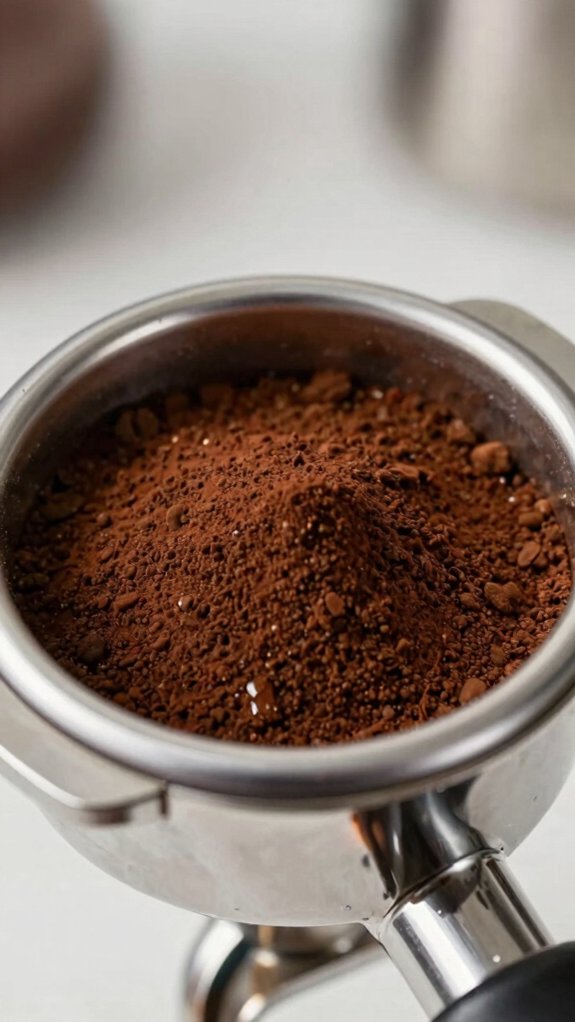
While you’re dialing in your espresso, you can actually feel when the grind is right. For the ideal grind setting, your espresso grounds should feel smooth and powdery, like fine sand or table salt. This fine grind and consistent grind texture is key for optimal extraction under pressure.
When you pinch properly ground espresso, it should clump slightly, showing good moisture. If it feels gritty or sandy between your fingers, it’s too coarse and will cause under-extraction, leading to sour shots.
That perfect, smooth feel means water flows evenly, giving you a balanced, delicious shot every time.
Trust your fingertips-they’re a great tool for dialing in.
Dial in grind by time and taste
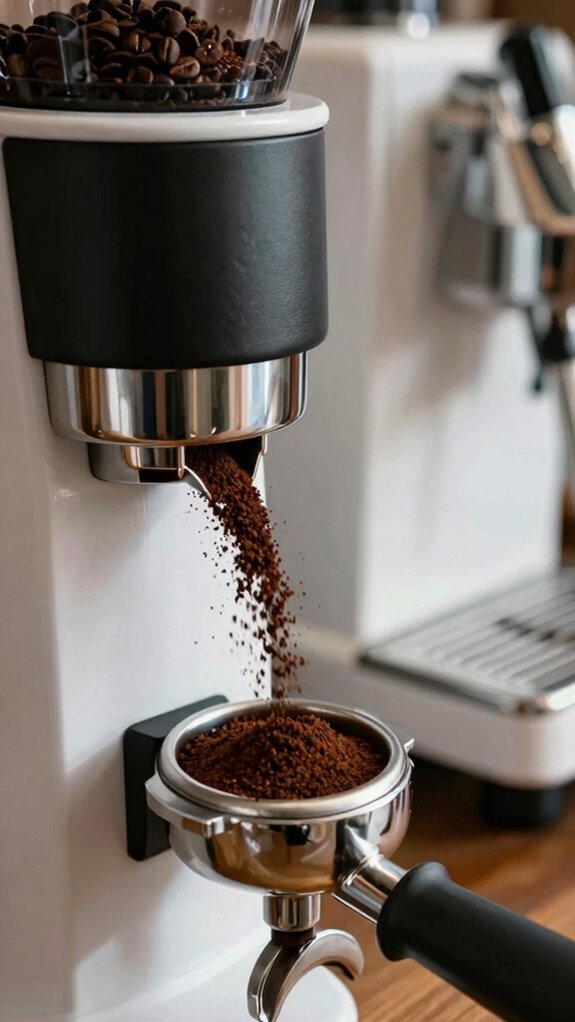
| Taste & Time Signal | Your Grind Adjustment | The Emotional Reward |
|---|---|---|
| Sour & too fast (<25s) | Go finer | Unlock sweet, vibrant clarity |
| Balanced & 25-30s | Perfect! Maintain | The joy of a perfect espresso shot |
| Bitter & too slow (>30s) | Go coarser | Achieve smooth, rich harmony |
Grinder burrs, calibration, and consistency tips
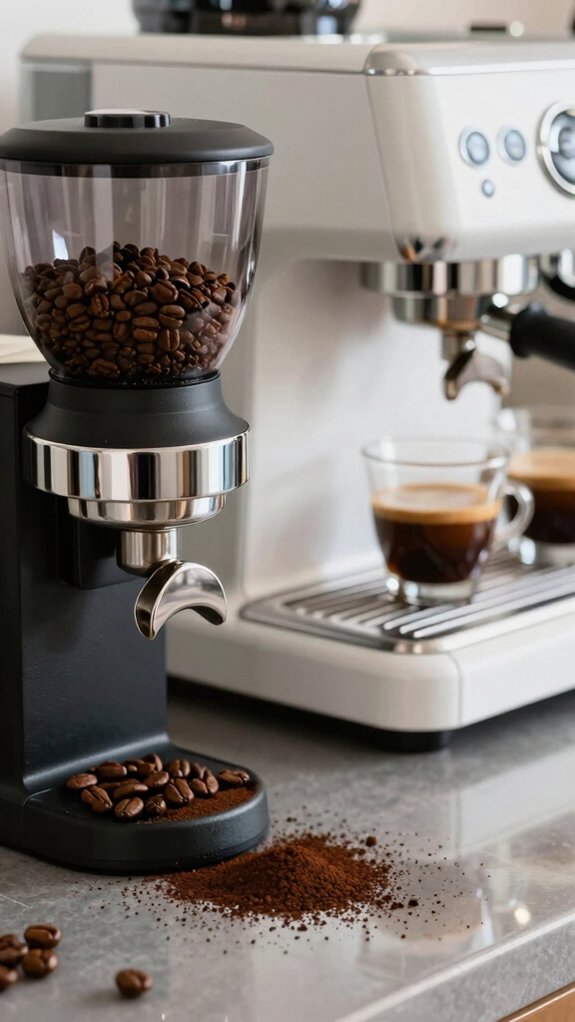
I always advise fellow brewers to regularly calibrate your grinder. As your coffee beans age, you’ll need to make small adjustments to the grind size to maintain your ideal 25-30 second shot.
Think of it like tuning an instrument. Aim for an espresso grind resembling table salt. This precision prevents bitterness or sourness, ensuring each shot is balanced and flavorful.
Your grinder’s stability is what turns good beans into great espresso.
What grind for pressurized baskets or pods
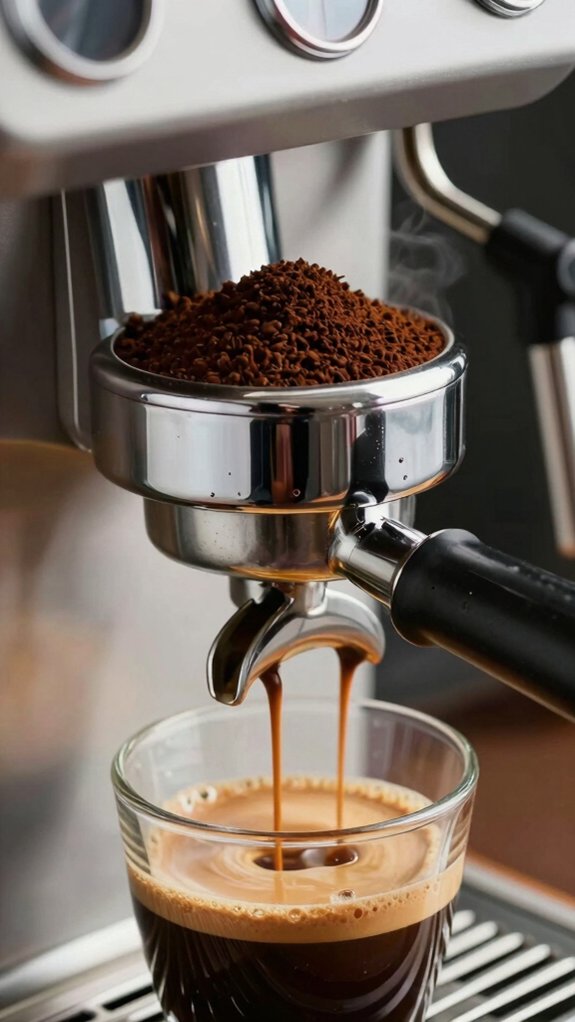
For those using pressurized baskets or pods, the ideal espresso grind is still a fine consistency, much like table salt, to create the necessary resistance for proper extraction.
I recommend a fine grind for pressurized baskets to build pressure for balanced espresso shots. Consistency in grind size is key for uniform extraction, preventing bitter or sour notes. A burr grinder is your best tool for achieving this uniformity with your coffee grounds.
Aim for a brew time of 25-30 seconds. This timing is crucial for optimal flavor extraction, ensuring your shot isn’t weak or over-extracted.
A little testing with your specific pod can fine-tune these results for a perfect, rich cup every time.
How to make espresso at home
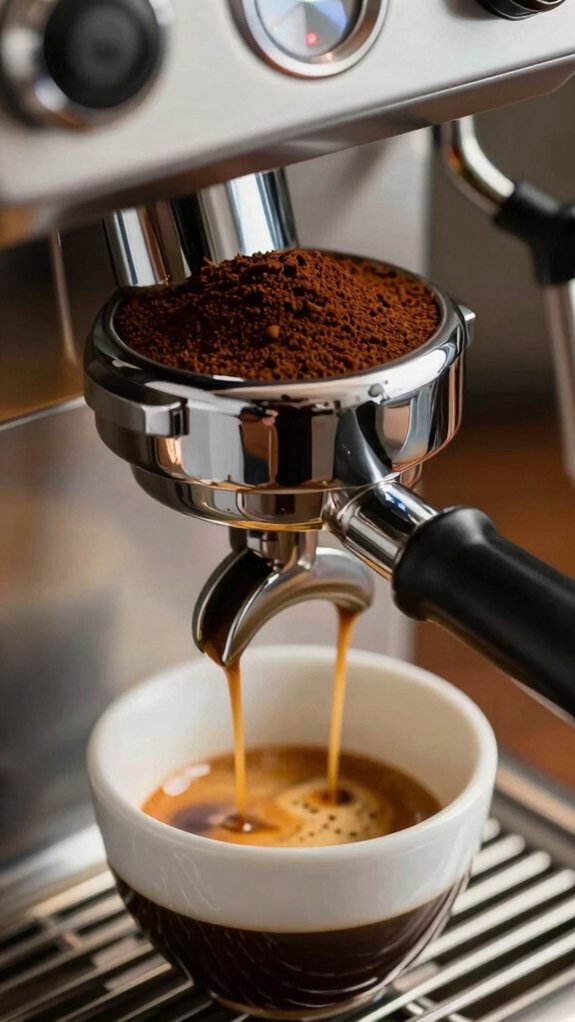
To make espresso at home, you’ll need just a few key ingredients and some essential equipment.
I’ll walk you through getting the right coffee and gear, then give you clear instructions for pulling your first shot.
Let’s start by gathering what you need so you’re ready to brew.
Ingredients
Crafting an exceptional espresso at home starts with two fundamental ingredients: freshly roasted coffee beans and clean, filtered water.
For your espresso machine, you’ll need about 18 to 20 grams of fresh coffee for a standard double shot. The grind sizes are critical; aim for a fine consistency like table salt.
I use a quality burr grinder for uniformity, which is key for a balanced extraction time of 25 to 30 seconds. Small adjustments to grind are my main tool for dialing in that perfect rich flavor and velvety crema.
Equipment
Beyond ingredients, having the right gear transforms your espresso from a hopeful attempt into a reliably great cup.
Start With Your Grinder
First, you’ll need a burr grinder. It’s essential for a consistent grind size, like fine table salt. This uniformity is the foundation for everything that follows.
Your Espresso Machine & Scale
Preheat your espresso machine for consistent brewing. I always use a scale to measure my coffee dose, aiming for 18-20 grams. Then, apply even tamping for a flat puck. This ensures uniform water flow.
Dialing It In
Finally, monitor your extraction time. Aim for 25-30 seconds, adjusting your grind to hit that target for perfect flavor optimization.
Instructions
Now that you have your equipment ready, let’s walk through the actual process of pulling a great shot at home. I’ll break it down into simple, repeatable steps so you can enjoy cafe-quality espresso without leaving your kitchen.
First, use a burr grinder for a fine grind resembling table salt. Dose 18–20 grams into your portafilter.
Then, tamp evenly with firm pressure to form a level coffee puck.
Start your extraction. Target a 25–30 second extraction time for a balanced espresso shot.
If it runs too fast or slow, adjust grind size finer or coarser.
Always maintain a brew temperature near 200°F (93°C) for optimal flavor without bitterness.
Fix channeling with simple puck prep
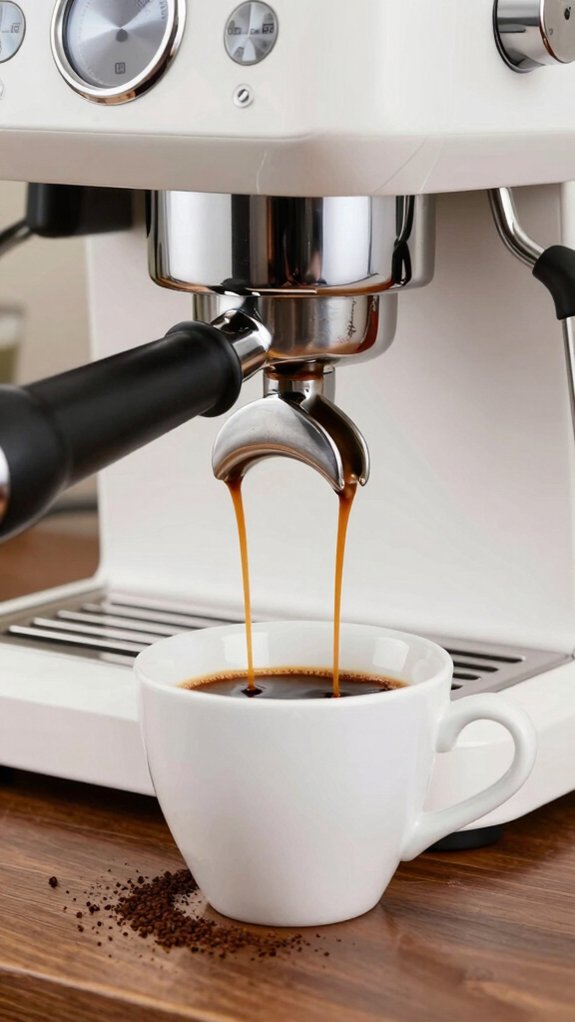
Dosing and Distributing: I dose 18-20g of ground coffee into a clean portafilter, then gently tap the sides to level the bed.
Breaking Clumps: I check my coffee grounds for clumps, breaking them up with a needle or using a distribution tool.
Tamping: I apply my tamping technique, steady, vertical pressure, to create a uniform, firm puck.
Final Inspection: I visually check for a perfectly flat, smooth surface before locking in the portafilter.
Frequently Asked Questions
How Fine Should Coffee Grounds Be for Espresso?
I grind my espresso to a fine, powdery consistency, like table salt.
This creates the needed resistance for a proper 25-30 second extraction.
I adjust it finer if my shot runs too fast and sour.
What Is the 2 1 Rule for Espresso?
I’ve found the 2:1 rule is a key ratio for espresso.
It means for every gram of coffee I dose, I aim for a two-gram yield.
This helps me dial in flavor and consistency in my shots.
What Is the 80 20 Rule for Coffee?
I wish I could say it means 80% of my coffee enjoyment comes from only 20% of the mess I make.
Really, it’s the principle that focusing on a few key brewing factors creates most of the flavor.
Is 15 or 20 Bar Better for Espresso?
I believe neither 15 nor 20 bars is better; 9 bars is ideal.
Higher pressures over-extract coffee, creating bitterness. I use 9 bars for balanced flavor and rich crema, which is the traditional standard.
In Conclusion
So, for perfect espresso, grind your coffee like fine table salt, a timeless tool telling you when you’ve hit that sweet spot.
Master this, and you’ll pull balanced shots with rich crema every time.
Keep tweaking based on taste and time, and remember: your grinder is your best friend.
Now go enjoy that delicious, expertly crafted espresso. You’ve got this.